

The Story Behind the Dish:
Portugal has given the world many remarkable foods.
But perhaps none travels quite as well as the little custard tart known as Pastel de Nata.
The plural is Pastéis de Nata.
The story is closely connected to the Belém district of Lisbon and the Jerónimos Monastery.
Portuguese convents and monasteries historically used large quantities of egg whites for purposes including starching clothing. That left egg yolks available for cooking, helping inspire an extraordinary Portuguese tradition of yolk-rich sweets.
After religious orders were dissolved in Portugal in the 19th century, the recipe associated with the monastery eventually became connected to the bakery now known for Pastéis de Belém.
Today, custard tarts are everywhere.
Bakeries.
Cafés.
Train stations.
Neighborhood pastry shops.
One bite and you’ll understand why.
Crisp, flaky pastry.
Warm custard.
Caramelized spots on top.
Cinnamon.
Maybe powdered sugar.
And suddenly one tart doesn’t seem like nearly enough.
Why This Dish Matters:
Pastéis de Nata are the perfect Global Kitchen food.
They’re connected to history.
They’re deeply tied to place.
They’re approachable enough to make at home.
And they’re exactly the sort of thing that can make someone say:
“I want to go to Portugal and taste the real one.”
Mission accomplished.
Recipe at a Glance:
Prep Time: 30 minutes
Cooking Time: 12–16 minutes
Cooling Time: 15 minutes
Total Time: About 1 hour
Difficulty: Moderate
Makes: 12 tarts
Ingredients:
Pastry
- 1 sheet all-butter puff pastry, thawed but still cold
Custard
- 1¼ cups whole milk, divided
- 3 tablespoons all-purpose flour
- 1 cup granulated sugar
- ⅔ cup water
- 1 cinnamon stick
- 3 strips lemon peel, avoiding white pith
- 6 large egg yolks
- 1 teaspoon vanilla extract, optional
Finishing
- Ground cinnamon
- Powdered sugar
Preparation:
Step 1 — Prepare the Pastry
Lightly roll the puff pastry into a rectangle.
Starting from a short end, roll it tightly into a log.
Refrigerate approximately 15 minutes.
Step 2 — Prepare the Pan
Heat oven as high as your equipment safely allows, ideally 475°F–500°F.
Traditional tarts are baked extremely hot.
Lightly grease a 12-cup muffin tin.
Step 3 — Portion the Pastry
Cut the chilled pastry log into 12 equal rounds.
Place one round, cut-side down, into each muffin cup.
Using damp thumbs, press the pastry outward and upward until it forms a thin shell.
Keep the pastry cold while preparing the custard.
Step 4 — Make the Milk Mixture
Whisk ¼ cup milk with the flour until completely smooth.
Heat the remaining 1 cup milk until steaming.
Slowly whisk the hot milk into the flour mixture.
Set aside.
Step 5 — Make the Syrup
Combine sugar, water, cinnamon stick and lemon peel in a saucepan.
Bring to a boil.
Cook approximately 3 minutes without stirring.
Remove from heat.
Remove cinnamon and lemon peel.
Step 6 — Combine
Slowly whisk the hot sugar syrup into the milk mixture.
Allow to cool for several minutes.
Whisk the egg yolks in a separate bowl.
Gradually whisk some warm custard mixture into the yolks.
Then whisk the tempered yolks back into the custard.
Add vanilla if using.
Step 7 — Strain
Pour the custard through a fine-mesh strainer.
This gives us a smooth filling.
Step 8 — Fill
Fill each pastry shell approximately ¾ full.
Don’t overfill.
Step 9 — Bake
Bake approximately 12–16 minutes, depending on oven temperature.
We’re looking for:
- Deeply golden pastry
- Puffing custard
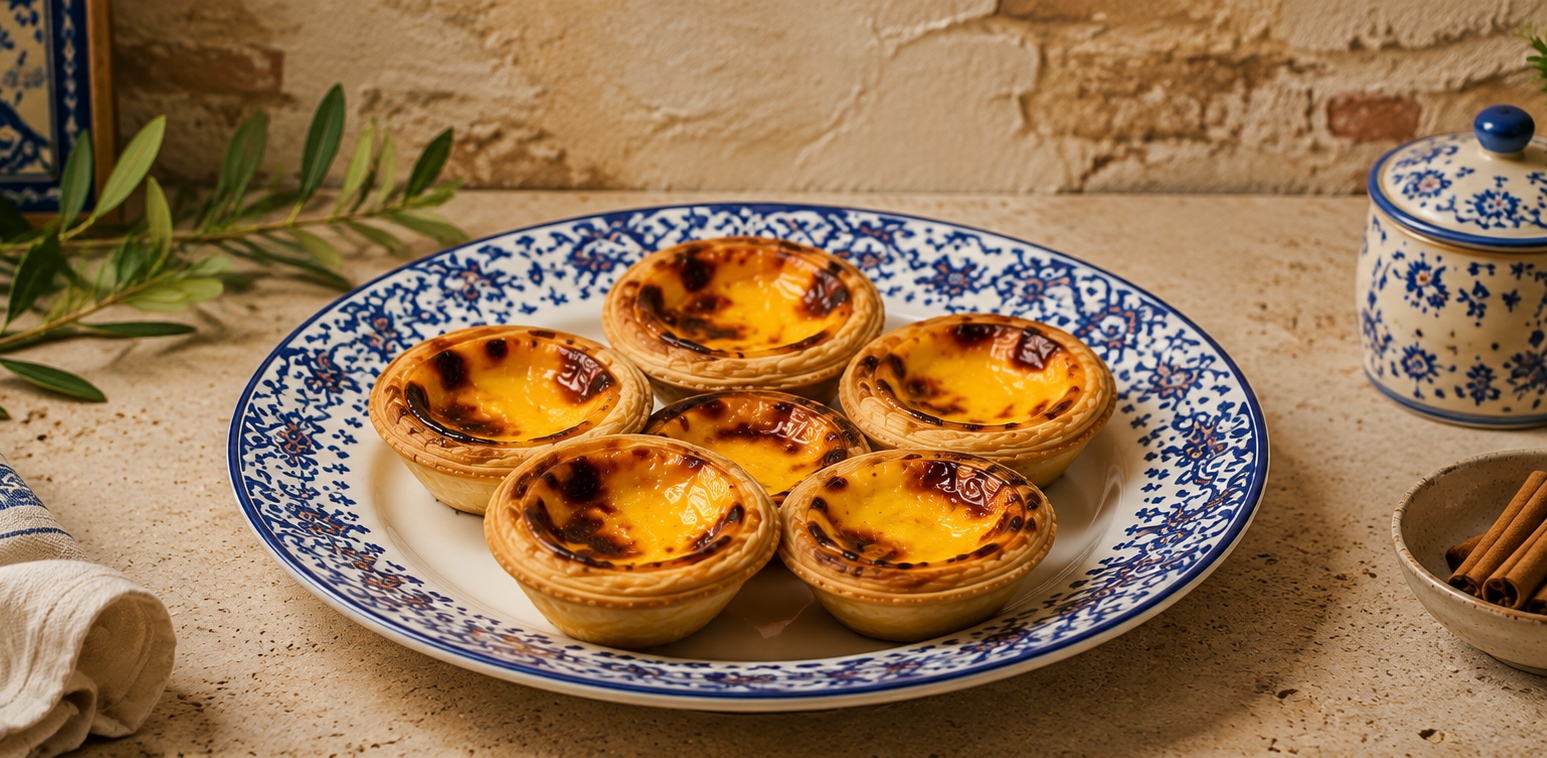
- Distinctive dark caramelized spots across the top
Those dark spots aren’t mistakes.
They’re exactly what we want.
Step 10 — Cool
Allow the tarts to cool approximately 10 minutes in the pan.
Carefully remove them.
Serve warm or at room temperature.
Dust with cinnamon and powdered sugar if desired.
Chef’s Notes:
A home oven can’t completely reproduce the extraordinary temperatures of a commercial Portuguese pastry oven.
That’s okay.
Use the highest safe temperature your oven and pan allow.
And don’t panic when the custard develops dark spots.
That’s part of the character of a great Pastel de Nata.
Garnishing & Presentation:
Keep it traditional and simple.
Serve warm with:
- Ground cinnamon
- Powdered sugar
Put several on a Portuguese-style blue-and-white plate if you have one.
Add espresso.
Then hide one for yourself before everyone else discovers how good they are.
☕ Beverage Pairing:
Coffee: Portuguese espresso
Wine: Tawny Port or Moscatel
Family-Friendly: Hot chocolate, café-style steamed milk or cinnamon tea
⏱️ 5-Minute Travel Version:
Buy good-quality custard tarts from a bakery.
Warm them gently.
Dust with cinnamon.
Make espresso.
Put on Portuguese music.
We’re calling it cultural research.
✈️ Gregg’s Passport Notes:
When you visit Lisbon, go to Belém.
See the monastery.
Walk along the Tagus.
Explore the neighborhood.
And yes…
Eat the pastry.
Actually…
Eat one warm.
Then have another.
There are moments when calorie counting and international travel simply don’t belong in the same sentence.
This is one of them.
📍 Where to Experience It:
Belém — Lisbon, Portugal
For travelers interested in the history behind Portugal’s famous custard tart, Belém belongs on the itinerary.
The protected name Pastéis de Belém refers to the famous version associated with the historic bakery there, while pastéis de nata are made throughout Portugal.
Your assignment?
Try both.
📍 Central Texas Picks:
📍 HELP GLOBAL KITCHEN FIND IT LOCALLY!
We searched Waco, Temple, Killeen and the surrounding area but haven’t yet found a restaurant where we can verify this authentic Portuguese favorite.
Know one? Tell us!
Send us the restaurant name and location. We’ll check it out and may feature your recommendation in a future edition of Travel-a-Go-Go Travel’s Global Kitchen.
🌎 Turn This Recipe Into Your Next Vacation:
Imagine starting the morning in Lisbon.
You’ve been walking for an hour.
You stop at a café.
An espresso arrives.
Beside it…
A still-warm custard tart.
You dust it with cinnamon.
The pastry shatters slightly when you bite it.
The custard is warm.
The coffee is strong.
And for a few minutes…
There is absolutely nowhere else you need to be.
That’s Portugal.
And when you’re ready to experience that morning instead of imagining it…
Travel-a-Go-Go Travel will help turn the dream into the trip.
Dream Trips. Done Deals. Relax…We’ve Got This!
✈️ Next Stop…
Next week, our passports take us to MOROCCO 🇲🇦, where fragrant spices, colorful markets, ancient traditions and the culinary influences of Africa, Arabia, the Mediterranean and the Berber world meet around one remarkable table.
We’ll show you how to make the flavors at home…
Explore the culture and stories behind them…
Help you discover where you may be able to experience them locally…
And when you’re ready…
We’ll show you where to experience the real thing in Morocco.
Until then…
Keep exploring.
Keep cooking.
Keep dreaming.
Because every unforgettable journey begins with a single step…
…and sometimes that step begins in your own kitchen.
I’ll meet you at the next gate.
Gregg Dungan
Owner & Travel Advisor
Travel-a-Go-Go Travel
Part of the Travel Without a Ticket Series
Bringing the World We’ve Traveled…to Your Dining Table.